


CUTTER BUSINESS TECHNOLOGY JOURNAL VOL. 34, NO. 5

In our fourth article, Aswani Kumar Cherukuri, Annapurna Jonnalagadda, and Cutter Consortium Senior Consultant San Murugesan look at potential applications and impacts of AI on education. Although not initially embraced by the education sector, AI can help students receive personalized lessons, provide educators with deep insights into students’ learning styles, revolutionize skills improvement for professionals, and lower the cost of education. The authors present the AI technologies being applied in education and then describe the platforms and applications now available in each of eight categories: adaptive and personalized learning; content preparation; proctoring and assessment; online learning and immersive learning through augmented reality/virtual reality; language learning; coding and robotics; tutoring and mentoring; and management and scheduling.
Artificial intelligence (AI) and machine learning (ML) technologies have progressed significantly and rapidly in the past few years. Almost every sector, including education and training, is being influenced by these technologies.
Until about 10 years ago, the education sector had not embraced AI because it lacked the required level of digitalization. Today, the education sector is witnessing a massive transformation from “chalk-and-talk” classrooms to “click-and-learn” digital environments. As education and learning become predominantly digital, there are opportunities to enhance them through AI and other technologies, such as augmented reality (AR), virtual reality (VR), and cloud computing. According to a report from Research and Markets, the AI market in the education sector is estimated to reach US $3.68 billion by 2023 and $5.8 billion by 2025. The report predicts the education sector to grow at a CAGR of nearly 48% during the period 2018-2022.1
In this article, we discuss how AI impacts the teaching and learning experience and the quality of education. We discuss an AI technology stack that can be applied to various educational processes and provide a summary of AI applications and platforms, along with their key features. We also look at why a cautious approach is best when adopting AI technology for education.
Impact of AI in Education
AI-based learning platforms are being used to personalize curriculum, content, online classes, and learning assessments. This is having a positive effect on students, teachers, educational institutions, and business professionals in various ways:
-
Students receive adaptive, personalized lessons that help them more easily understand complex concepts, along with customized assessments that identify their competencies and learning gaps.
-
Educators gain deeper insights into students’ learning styles, helping them analyze student performance and knowledge gaps and follow data-driven teaching methods.
-
Teachers improve their efficiency by automating managerial activities like assessments.
-
Institutions can offer higher-quality, more affordable education and achieve better student retention, thanks to the scale of online education.
-
Business professionals can improve their skills and explore new knowledge areas.
AI is helping educators create and curate customizable digital content that lets grade school and higher ed students learn in a more personalized way using skill mapping and microlearning. Using AI-powered learning paths, platforms like Coursera and edX offer courses aimed at both students and professionals worldwide. With on-demand digital education, students and professionals gain knowledge and skills at their convenience and on their own timeline.
As students access digital content, educators get real-time feedback on each student’s knowledge gaps and areas of difficulty. AI systems also help educators create personalized learning paths for students. AI-fueled analyses provide detailed information about where students are failing and, more importantly, why they are failing.
Intelligent assistants and autonomous chatbots provide assistance to students, reinforcing the concepts being taught, and they can challenge students with microtasks. At the higher education and research level, AI-based graphics processing units like those from Nvidia provide cost-effective, efficient hardware and software stacks for high-performance computing. This infrastructure equips graduate students and researchers to accelerate AI-based research in various scientific fields.
AI is helping educators reduce the amount of time they spend planning, scheduling, and doing managerial tasks. AI facilitates automation in student admissions, monitoring and alerting about student absenteeism, budgeting, HR management, and parent interactions. In general, it enhances learning outcomes, productivity, and employee engagement in corporate learning and training. AI-powered personalized training, digital learning assistants, data-driven insights, and feedback are proving effective for both employees and organizations. Students tend to dislike learning through reinforcement (learning from failure); using gamification, AI-powered educational platforms allow and even encourage students to explore and learn from failures.
Here are the key benefits that AI-based education offers over traditional instruction modes:
-
Adaptive and gamified learning
-
Automated content preparation and curation
-
Efficient proctoring and automated assessment
-
Analytics-driven student performance analysis
-
Adaptive team formation and collaboration
-
Personalized skills development and competency building for professionals
-
Skills enhancement, including language, comprehension, critical thinking, and problem solving
-
Tutoring and mentoring
-
Immersive learning
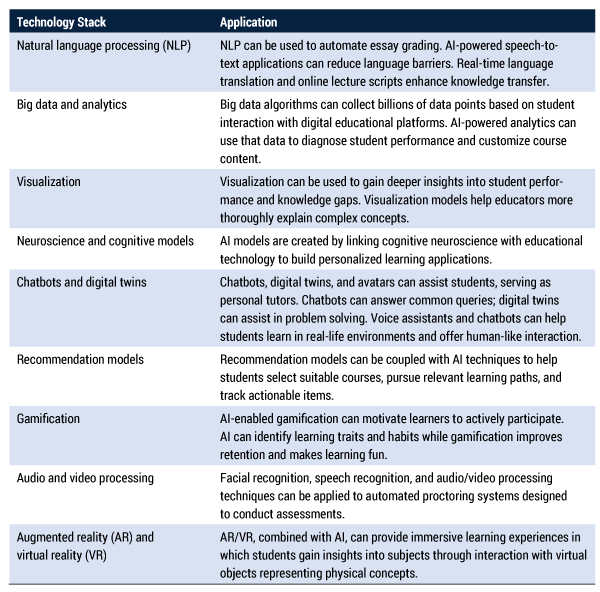
A number of AI technologies are being applied in education to achieve these advances. Table 1 provides a brief summary of the technology stack.
AI-Powered Educational Platforms
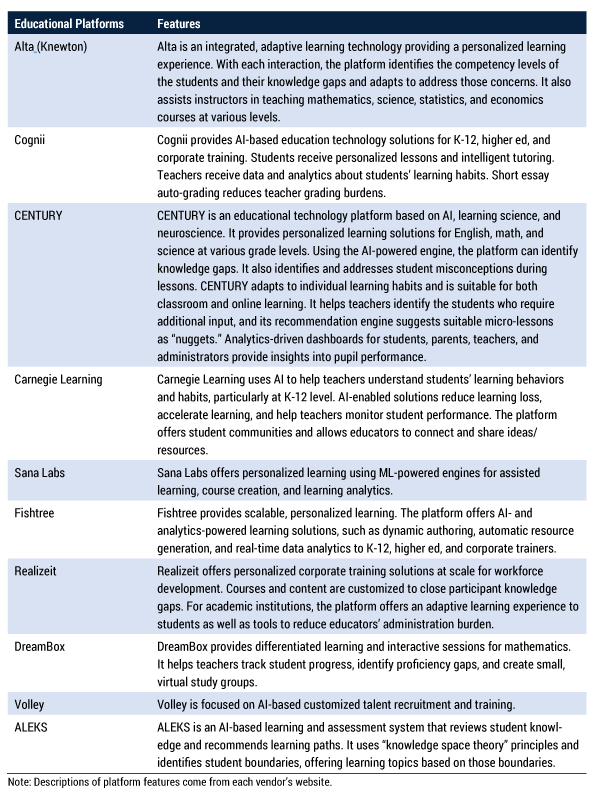
Many AI-powered educational platforms and applications are now available to help educators leverage AI. We’ve grouped these platforms based on their features to create Tables 2-9, of which applications, listed in no particular order, enable these functions:
-
Adaptive and personalized learning
-
Content preparation
-
Proctoring and assessment
-
Online learning and immersive learning through AR/VR
-
Language learning
-
Coding and robotics
-
Tutoring and mentoring
-
Management and scheduling
The platforms in Table 2 use AI to analyze the knowledge gaps in learning and offer personalized learning paths to the students. Some of them provide insights into why these learning gaps arise and create recommendations for educators.
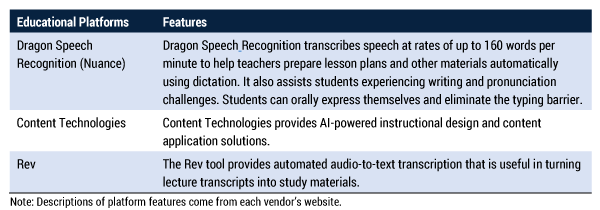
Creating lesson content and study materials for the students is an important task. AI is helping educators create and curate content from multiple sources. Table 3 briefly describes a few AI-powered educational platforms designed to assist with content preparation.
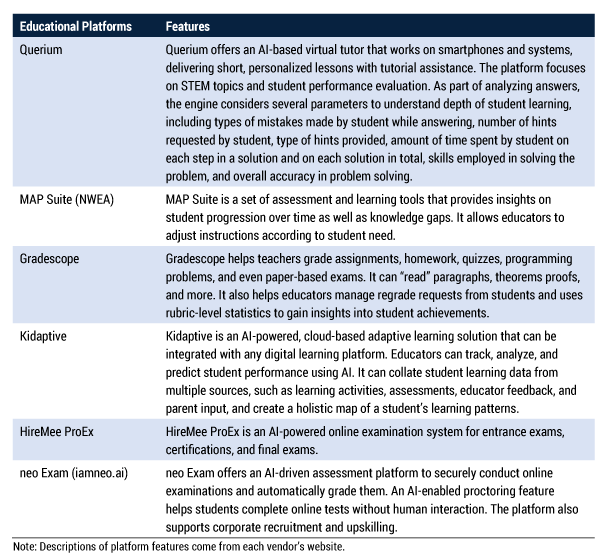
Learning assessments and grading are essential educational processes. AI-based tools are helping educators conduct learning assessments and gain insights into student learning gaps. Table 4 highlights a few such platforms.
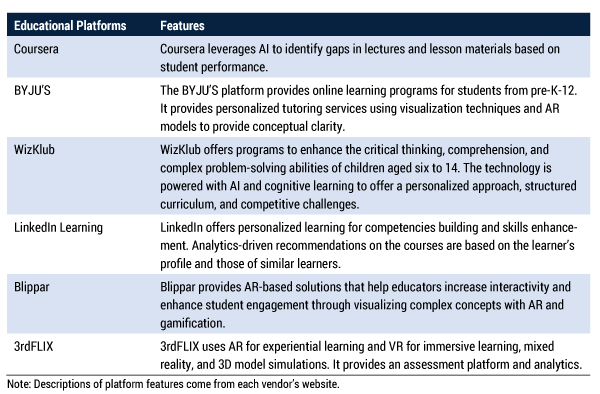
Online learning platforms leverage AI technology to personalize learning paths and understand gaps in learning and teaching. AR/VR-assisted learning platforms provide an immersive learning experience that can lead to a richer understanding of complex concepts. These AI-powered platforms allow educators to understand and analyze students’ cognitive responses during the learning process. Table 5 presents some of these tools.
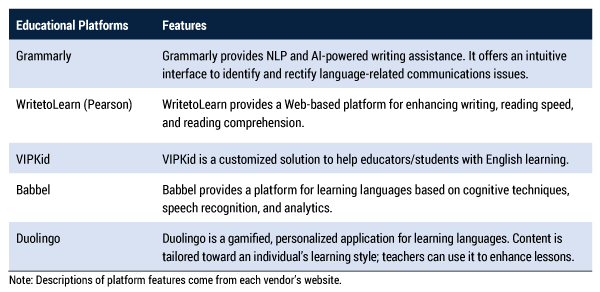
Several AI powered platforms aim to help students learn languages and improve their communication skills. Some of them help educators improve their course materials. Table 6 offers a brief summary of a few such platforms.
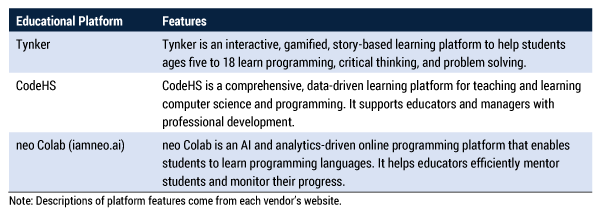
There are few AI-based platforms that teach students coding, programming, and basic robotics. Table 7 highlights a handful of platforms.
There are several AI-powered platforms that assist students by providing personalized tutoring. Some of these platforms use gaming principles. Table 8 illustrates some platforms.
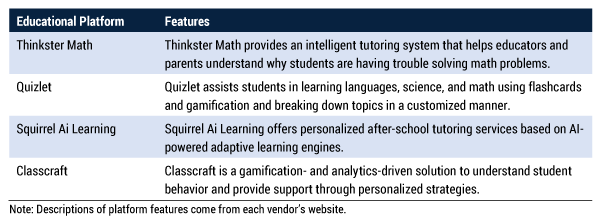
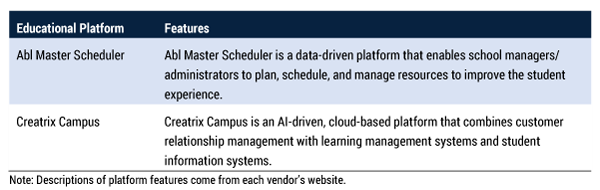
In addition to teaching and learning, AI-based solutions can assist institutes with management and resource utilization. Table 9 provides a brief summary of two such platforms.
Final Thoughts
AI’s adoption by the education sector is in a nascent stage, with vast opportunities for growth as technologies and solutions mature. There are some caveats, however.
First, machine interaction should not take the place of human interaction, and we should not ignore the importance of soft skills, such as peer interaction, teamwork, and collaborative learning.
Second, there are ethical aspects of AI to be addressed, including bias and the potential for discrimination. There is evidence of human biases in data annotations that result in biased AI algorithms. The amount of data and training data sets is limited in the education sector, so reducing algorithmic biases in educational applications can be challenging.
Finally, there’s a need for extensive research on the effects of the pedagogy, instructional models, and learning paths within online learning applications on the overall development of student learning.
Aspects such as empathy, experiences, use case identification, student motivation, role-model pursuit, personal interactions, and cognitive connections are all important and cannot be taught by algorithms. AI’s role should be to assist educators, not replace them, while helping students learn more efficiently.
Reference
1“Artificial Intelligence Market in the US Education Sector 2018-2022.” Research and Markets, August 2018.


